9 SEO Mistakes Small Businesses Make in 2026
Here are 9 common SEO mistakes that we see small businesses make in 2026.
1. Treating SEO as a one-off job
SEO requires ongoing updates to your website and associated SEO activity for best results. This is why SEO should be considered as part of your long-term digital marketing strategy rather than a one-off job that you do whilst you’re building your new website.
Search engines like Google want to provide their users with up-to-date, relevant and reliable information, so if your website remains dormant then it won’t have the same visibility as a site that that is frequently updated and optimised for search engines.
2. Not adding or updating existing content
#2 goes hand-in-hand with #1, but some small businesses focus on the one-page SEO for their initial website build and do everything right in-terms of on-page optimisation, adding meta descriptions, schema markup etc, but then neglect their website by not adding or updating their website content thereafter.
Having a blog feature on your website is fantastic for being able to add additional website content over time. If you think of wanting to get your website being listed on page 1 in search engines in the same way as playing the lottery, then the more pages (or lottery tickets) you have then the more chance you have of being found (or winning). If you’re able to commit to publishing a blog post every week, then that would be an additional 52 pages a year that can be indexed and found by people searching online for your products or services, meaning you have a better chance of being found (or winning the lottery).
Updating existing page content on your website also helps to improve its chances of getting found. Top tip is to add an FAQ section to your service or product page if it doesn’t already have one.
3. Having one page for every service and location
A common SEO mistake that we see many small businesses make is that they use a single service page to list all their services and locations. This makes it harder for search engines to know what keywords to best rank you for and essentially dilutes your messaging. From an SEO perspective you should separate your services and locations with individual landing pages so that you are single-minded with what you want keyword terms you’d like search engines to rank your page for.
So, move away from a site map that looks like this:
Home | Services | About Us | Contact Us
And expand to a site map that has an individual landing page for each of your services and locations, just like how we’ve done it for our client HCB Widdows Mason solicitors.
4. Neglecting your Google Business Profile
Having a strong localised presence with your Google Business Profile is a valuable asset for small businesses whose main or entire client base is local to them. A Google Business Profile is entirely free to set up and is a great way of driving traffic to your website by appearing in an online shop window from a localised Google search (Bing Places for Business is the Bing alternative which is also free) such as ‘roofers in Cardiff’.
You should optimise your Google Business Profile for maximum visibility in search engines, rather than treat it as a one-off ticking exercise (we’ve had to help so many clients of ours to retrieve their Google Business Profile as they set it up years ago and no longer have the logins for it). You can optimise your page through updating your business description, list of services that you provide, uploading relevant company photos, publishing posts and asking for client reviews. Having a strong review rating from multiple reviews significantly increases the likelihood of a user clicking on your listing once you’ve appeared in a localised Google search.
5. Copy and pasting AI generated content
While AI tools like ChatGPT are powerful and super-efficient for creating web content, they should be used as an assistant rather than as the source for copy and pasting a load of web content onto your website. AI produced content is often generic, includes factual errors, and doesn’t include the first-hand perspectives and expertise insights that search engines and users value.
We therefore recommend utilising AI tools to generate topics to write about and even first drafts for you to amend, rather than doing everything for you at scale.
6. Ignoring AI search and AI Overviews
AI is continually changing the landscape of so many things in our day-to-day lives, and search engines are no exception. Long gone are the days that a Search Engine Results Page (SERP) is just a list of ten blue links. Google AI Overviews and other AI search experiences now summarise information before you even see the organic listings.
Like major search engines, AI search rewards websites with good authority and want to call and display information from trusted sources. Make your business information, expertise, services, locations, plus evidence and supporting content clear and consistent. In doing so, you help boost your chances of being found in SERP and AI overviews.
7. Using multiple H1 Tags on a single page
A H1 tag might not mean much to anyone that doesn’t understand website code, which is completely fair. Basically, a H1 tag is an element of HTML code that marks the main headline or title of a web page.
For SEO purposes, a well-structured page should have a single H1 tag and use logical H2 and H3 tags throughout the rest of the page to make it easy for search engines to know how to digest your information and what keywords to rank you for. Many small businesses use multiple H1 tags throughout their pages as it ‘looks nicer’, meaning that they compromise SEO structure for aesthetics. CSS controls how a headers look, so tweaking the style of your H2, H3 (and so on) headers mean that you can have both good SEO AND a good-looking web page.
A quick example of how you should structure header tags throughout your website is:
- H1 – How to guide for using headings for SEO purposes
- H2 – What are headings
- H2 – Why are headings important
- H2 – How to add headings in WordPress
- H3 – An example of heading structure
8. Sacrificing poor page speed by using large files for images and videos
Displaying high-impact image and videos are definitely recommended to help improve your conversion rates, but often small business owners are uploading high-res images or chunky videos to their site that are just too big in file size. In doing so, these media assets negatively affect your SEO performance and user experience with poor loading page speeds, particularly for mobile users in a weak connection area to their network.
You can avoid this common mistake by reducing file sizes before you upload them to your website. Consider utilising free tools such as TinyPNG for images, or Handbrake for videos. Aim to get your images within 150kb and videos to be under 10MB before adding them to your website. You can even upload videos to YouTube or Vimeo and embed them onto your website as an alternative to effectively showcasing videos on your website without compromising on page-speed performance.
9. Not tracking performance
Possibly the #1 common mistake that we see small businesses make frequently is that they spend more focus, time and money on the appearance of their website than they do on marketing it. Driving traffic to your website is just as important, if not more important, than having a great website that converts web traffic into enquiries.
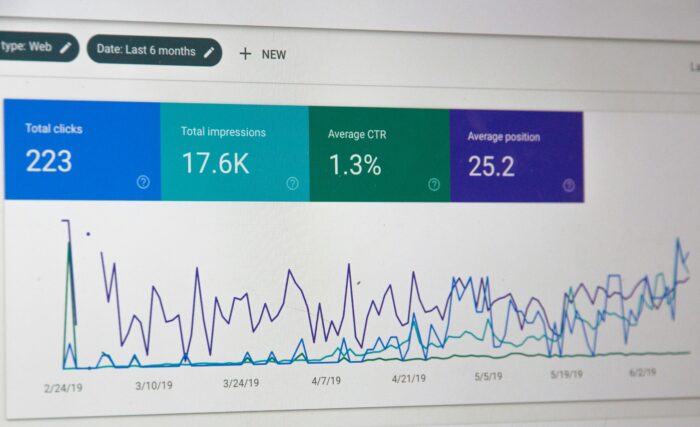
From an SEO perspective, you can track your website’s performance in Google search, as well as page index statuses, and technical SEO data, using a free tool called Google Search Console. It’s free to use and is our go-to tool for measuring search engine performance in Google. You can view the exact words that people type to find your site in a Google search, clicks and impressions from those searches as well as your average position. It takes out all the guess work that many small businesses do through manually Googling what they think their customers might be searching for and going through the pages to find their own website listing.
Utilising free tools such as Google Search Console will help you uncover any quick fixes that need resolving and give you data that can help you further optimise your website for improved visibility, increased clicks, enquiries and sales.